Let’s Talk About Reach, Baby!
"The internet is beautiful. The internet is important. Connecting people and giving people a way to reach each other, and speak, and make media, and distribute that media, that’s awesome. But the systems and subsystems that we’re using layered on top of the internet, like social media, those systems are a bad implementation of those principles that have had a really harmful effect on humans at a scale that is hard to even comprehend."
— Jack Conte, CEO of Patreon
A month ago, I shared that I was rethinking social media. In an ideal world, I wouldn’t create media for platforms that have been found to ignore defects in their products to the detriment of users’ health. But we don’t live in an ideal world, and I want a way to reach more people with the media I make.
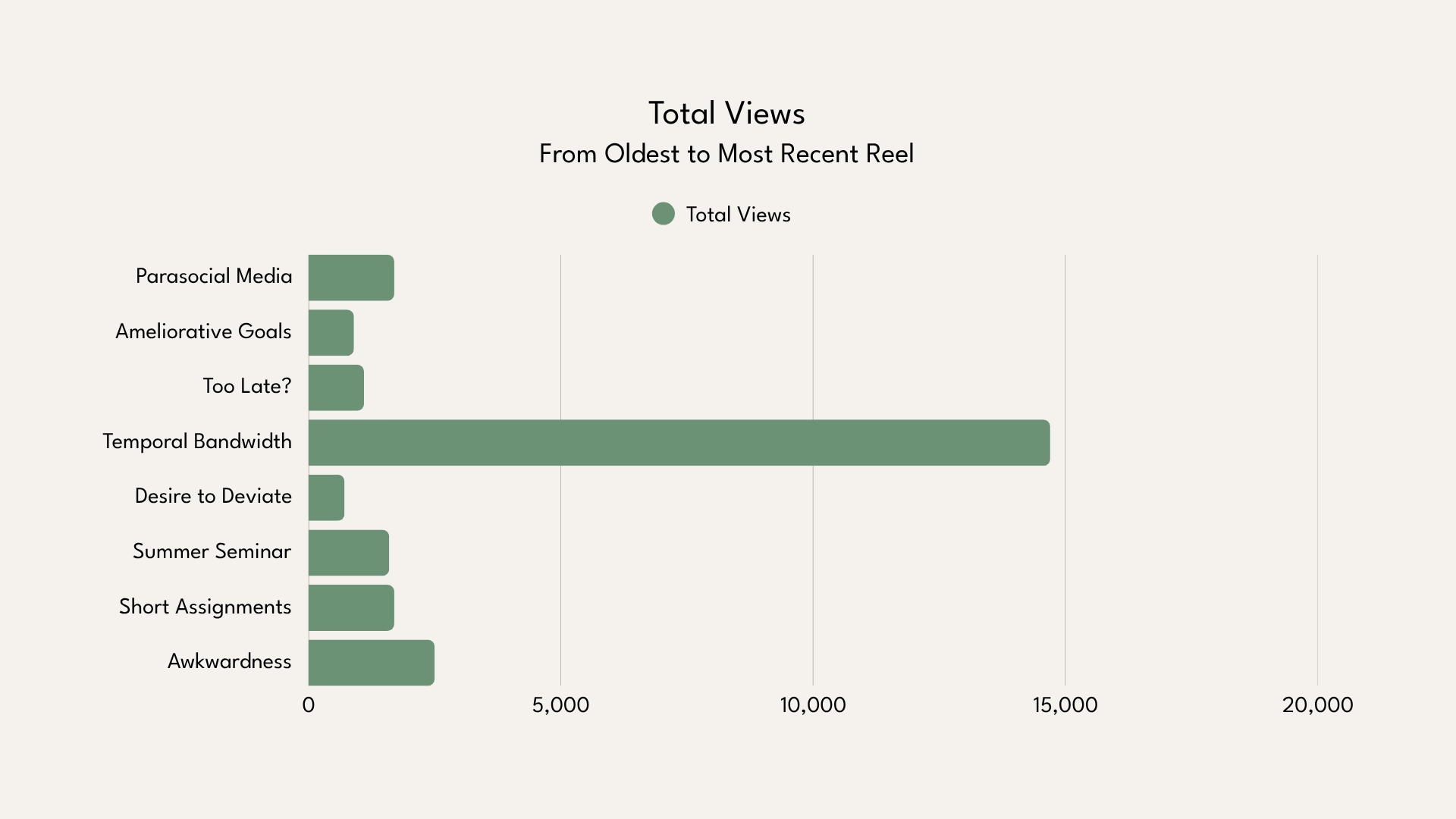
Anyhow, I started my foray back into the jaws of the algorithm on Instagram, where I have a modest follower base. I’ve posted eight Reels, short vertical videos, direct-to-camera. So far, I’ve used three formats: (1) idea from a book, (2) idea from my long-form content, and (3) life and work advice (Tara’s Version).
What I expected was that I’d post my first video after a long hiatus and get some solid reach (around 10-15% of my total follower count in views). Platforms love to reward you when you come back after time away. Then, I expected to see a significant drop-off in views (perhaps 1-2% of my total follower count). And then I’d get into a rhythm, see what was working, and hopefully reach an equilibrium (maybe 4-5% of total follower count).
Well, that is not what happened!
My first video did about as well as I expected—about 14% of total follower count in views. The second video did see a big drop—about 6% of total follower count in views. The third video did slightly better.
Then, my fourth video broke containment. It got 113% of total follower count in views. For what it’s worth, it was the first video that was made with Edits, Instagram’s own video editing app, which seems to help with reach. And to be clear, I edited the thing in Final Cut Pro first and then added some bells and whistles in Edits because this girl doesn’t have the patience or eyesight to edit video on her phone.
Next video? Big drop (about 5%). The last three have reached more than 10%.
So this was all very surprising. My hypothesis was completely shot.
But even more surprising than the view counts themselves was how they broke down between followers and non-followers.
Allow me to don my Elder Millennial Internet Grandma hat. Back in my day, reach came first from followers, then from non-followers. That is, the algorithm would serve content to those who indicated they wanted to see it first. Then, if those people engage with it, the algorithm might serve it to people similar to them.
Suffice it to say, Instagram’s algorithms have changed while I was away.
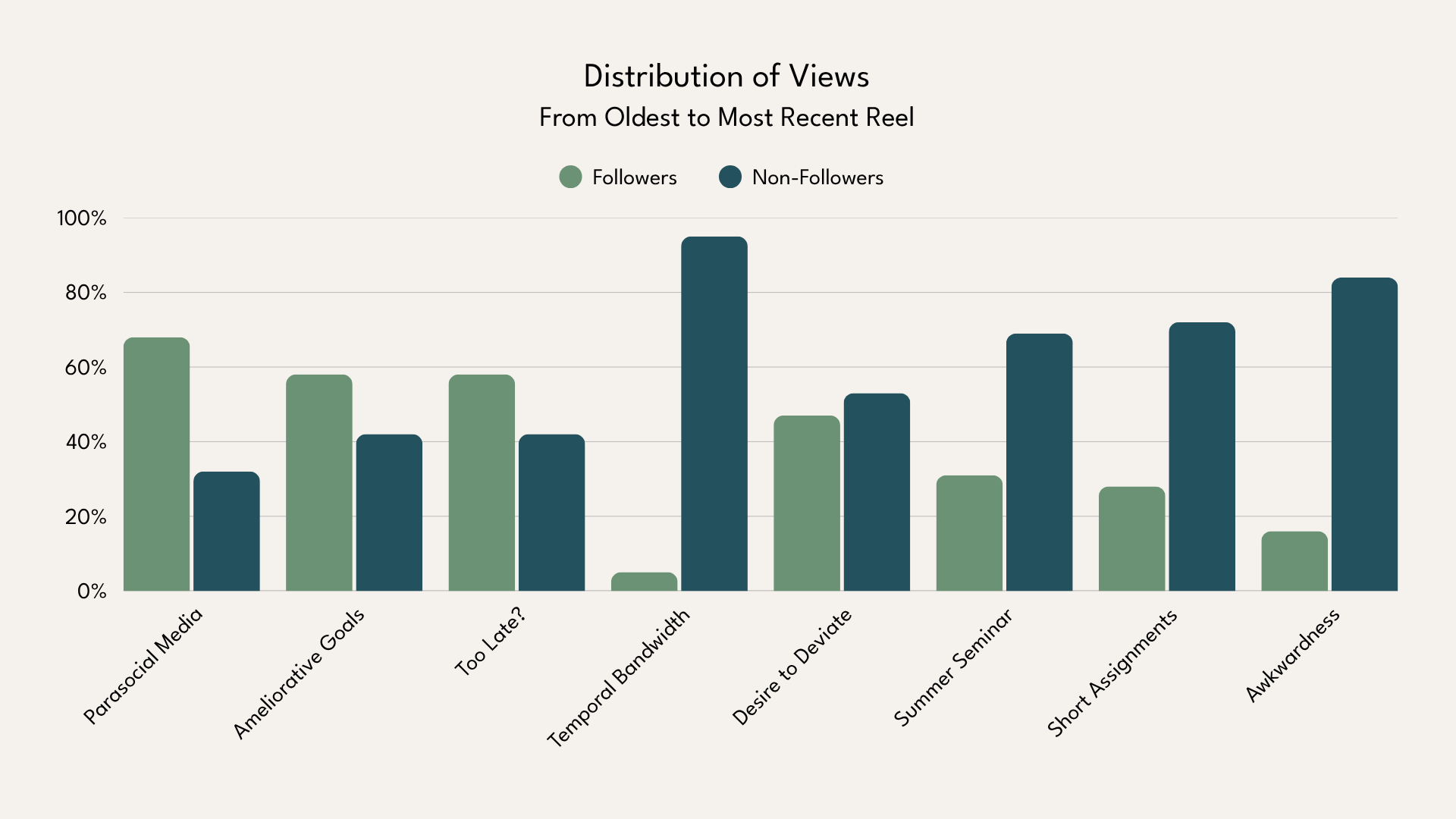
More than 30% of my first video’s views came from non-followers. More than 95% of views on the video that broke containment came from non-followers. And more than 85% of views on my last video (posted June 22) came from non-followers.
Now, on one hand, this is what I was hoping for, right? I wanted to make social media again to reach new people and address my distribution problem.
On the other hand…
What?!
I came back to social media with a new perspective on how to create content (parasocial media). And I knew that algorithmic distribution had become more interest-based rather than follower-based. But I was gobsmacked by the sheer magnitude of the change I experienced. It’s not just creating parasocial media; it’s creating parasocial media for a parasocial algorithm.
In an interview on Decoder this week, Patreon CEO Jack Conte decried the loss of what he called “deterministic reach” on most social media platforms. What he means is that social media users have built audiences that they can’t reliably reach with the media they make:
“…when you move away from a follower paradigm, you ruin the creator’s deterministic line of reach to their fans.
If a creator can’t reach their fans, then not only can a creator not build a true community around their work, but they also can’t build a business around their work. The biggest shift in the creator economy, that I think has been the most impactful for creators and for Patreon as a business, is this shift of the internet away from follower-based paradigms and into interest-based paradigms.”
— Jack Conte, on Decoder
Deterministic line of reach. Determinism here refers to the way one set of inputs can be run through a computer program multiple times and every time the output will be the same, the same way 2+2 always equals 4 (unless you're doing weird mathematics things that I do not want to think about).
Email marketing has a fairly deterministic reach. I have a list of email subscribers. I email them. I'm relatively sure that my email will end up in 99% of their inboxes. Same thing with podcasting. When I publish a new episode, I know it’s going to show up in the podcast app of every subscriber.
Social media has never really had that kind of reliability, but there was a time when you could be sure you were reaching anywhere from 10-30% of your followers each time you posted. The question mark was always whether non-followers would see what you posted.
Today's media platform algorithms have completely flipped this calculation. Now, less than 3% of my followers see my content, even as my view counts tick up.
In the metrics I shared above, I’m using the percentage of total follower count as a ratio (followers to views), not the percentage of my followers I actually reached. My last video seems to have reached less than 320 of my 13k followers, or about 2.5%. The video before that did about the same, reaching about 360 followers, with fewer overall views. In other words, there is no way for me to reliably reach my followers on Instagram. No deterministic reach.
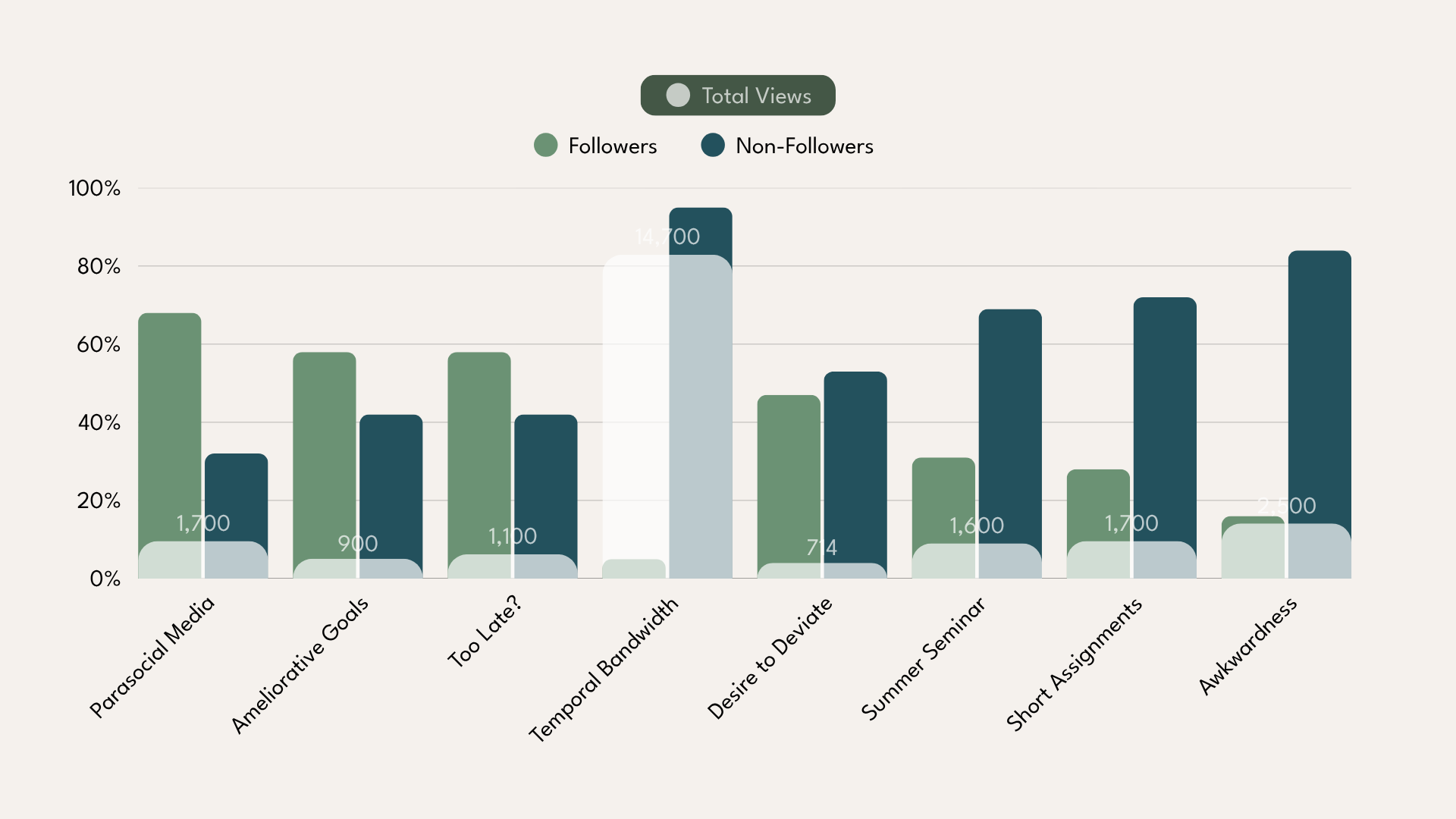
Again, speaking as your Elder Millennial Internet Grandma, I know this. I’ve known this. And these results were still shocking to me because who I am reaching is non-followers and at a much higher rate than I could have imagined.
Now, all of these numbers are just my results and represent only 4 weeks of what will likely be a 12-week experiment. Please don't take any of this analysis as definitive or as implicit advice. It absolutely is not.
Okay, so from a purely metric-based marketing objective angle, my experiment is a success. I wanted to reach new people, and I'm reaching way more new people than I expected. Boom! But, as ever, these results are just the tip of the iceberg metric—there's way more information below the surface.
I haven't looked too far into what's going on with my follower count in relation to video views (although it has gone up) or whether those video views are translating into more meaningful metrics like website visits or email subscribers. There's not enough data to derive much meaning from yet. I might not even have enough data or a clear enough trend to figure that out by the end of the summer. And that's okay. It's not really the hypothesis I was testing anyway.
What I'm left wondering is how reaching predominantly non-followers changes the media I create…
One of the lovely things about more deterministic reach is that you know you are largely communicating with a group of people who are more or less familiar with your work. For example, I don't worry about angering MAGA Republicans with my newsletter not—as I might like—because I am a courageous truthteller, but because I make my whole project off-putting to MAGA Republicans. It's not for them, and so they don't subscribe. Quoting Marx or taking the exploitation of the capitalist labor regime for granted isn't going out on a limb; it's quite comfy.
I can craft the media I make to ensure the algorithm mostly distributes it to little lefty nerds like me. But my work can have a much broader appeal, so I don't really want to do that. Or rather, my hypothesis is that there are lots of people out there who are a few well-reasoned vertical videos away from becoming little lefty nerds.
But there's also the opposite impulse. I can make media that appeals to lots of people to boost my reach and ensure more of the right people get to see it—hopefully opting to become followers or subscribers or customers. This isn't necessarily a bad strategy, but there are plenty of ways it can go very wrong. I might dilute my core message, attract viewers who inadvertently push my content in a direction I don't want to go, or simply focus more on reaching lots of people than saying what I want to say.
In the era of deterministic reach, "audience capture" could be a big problem for creators. Audience capture is a phenomenon in which a creator becomes overly responsive to their followers. It's a reinforcing feedback loop that encourages ever more siloed, extreme, or radical content. In paradigmatic examples, creators end up hurting themselves and/or others to produce the content their audience wants to see. But in less flashy cases, audience capture can lead people to make bad decisions. If you've ever watched a marketer pivot from selling one zeitgeisty strategy to another, you've seen a version of audience capture.
What I'm trying to say is that I don't think the incentives and impulses that are familiar as audience capture disappear just because you're not reliably reaching a consistent audience. Instead, audience capture is more diffuse, less recognizable, while at the same time flattening the expression of a wide variety of creators into the same memes, templates, and language.
Avoiding that flattening is tricky, though. I've modeled a few of my videos on the #bookstagram or #booktok style—which I feel good about. But then I've found myself tapping the books in front of the camera—a ubiquitous creator gesture I do not want to repeat. Luckily, I do not have the appropriate fingernails for actually pulling that off.
I digress.
I wanted to share all this—my messy first-pass analysis and my honest questions about how media gets made for the interest-based algo—because I know peering behind the curtain can be helpful. Mostly, I wanted you to know that if you feel confused by how platforms have changed or frustrated that everything you thought you knew about social media marketing has become increasingly obsolete, I'm right there with you.
This isn't what I expected from experimenting with social media again. But I'm always happy to have big, hairy, unexpected questions to consider.
Summer Seminar
✳︎
Out of Time
✳︎
Summer Seminar ✳︎ Out of Time ✳︎
Summer Seminar is back!
Summer Seminar is a chill reading and discussion group where there’s no such thing as being behind and no right answers.
Join me for 8 weeks of speculative fiction and critical (re)thinking. This year, our theme is “Out of Time,” reflecting on time, solitude, and hope. Learn more and register.