Short Assignments
"So after I've completely exhausted myself thinking about the people I most resent in the world, and my more arresting financial problems, and, of course, the orthodontia, I remember to pick up the one-inch picture frame and to figure out a one-inch piece of my story to tell, one small scene, one memory, one exchange."
— Anne Lamott, Bird by Bird
In terms of productivity advice and business books, I often recommend skipping the business section, bypassing the positive-thinking polemics, and heading straight to the shelves full of books on writing—the craft books. By "craft book," I mean a book about writing by a writer.
Writers think about how they get work done as a matter of course. They have to. Not only are they up against deadlines from their agent, their editor, or their mortgage company, they're up against the critics and bad-faith readers that live rent-free in their own minds. Their projects are rarely linear, almost never well-defined, and often evolving on a paragraph-by-paragraph basis.
I'm sure this is true of other culture makers, too. But writing is what I know about.
I first read Anne Lamott's Bird by Bird around 2010, I think. To that point, I knew her as the author of the unexpected hit among leftie Christians, Traveling Mercies. But I devoured Bird by Bird, and it's since shaped my approach not only to writing but toward work and business generally.
It was in Bird by Bird that Lamott coined the phrase “shitty first draft.” Well, I’m sure someone announced that they’d written (or read) a shitty first draft before 1994, but Lamott turned the “shitty first draft” into a strategy. A shitty first draft is, of course, that initial effort to complete a project. It’s not done, but it’s complete. The “shitty” part lowers the stakes, while the “first draft” part reminds you that this go at your story or essay or script is simply an opening volley.
Plenty has been written about the usefulness of shitty first drafts, so I’ll move on from this well-trod idea to an equally useful piece of advice from the book: short assignments.
Like the phrase “shitty first draft,” the idea of short assignments sort of speaks for itself. Lamott advises writers to focus on their daily writing at an atomic level. Instead of writing a chapter or, worse, “working on” your project, you decide to tackle a scene or a conversation or a description of the corner of Main and Broad in the small town your story takes place in. Not only does this help overcome the anxiety of open-ended writing, but it also helps you focus on the details, the moments that help writing really come alive.
And that's what sets it apart from more cliché advice that tries to communicate the same sentiment.
Writers know that every paragraph has a purpose. It's not merely a unit of work but something critical to the goal of the piece as a whole and something that has its own unique goal. A paragraph, therefore, isn't a short assignment. But a paragraph that elucidates a piece of evidence or describes a banal situation with heartbreaking clarity is.
I landed on social media in the era of Twitter’s heyday, long before the character limit was increased to 240 and lengthy threads dominated discourse. When I turned my attention to Instagram, I worked within its less onerous but no less real character limits. I operated more or less comfortably in the realm of short assignments. For the most part, strong marketing content demanded brevity and clarity.
When I stopped writing for marketing purposes and started to just write, I discovered that I had even more to say than I realized. This will come as no surprise to you. I got comfortable writing 3000 words, then 5000 words, and then I let loose a 10,000 word piece. It was like the floodgates had opened, and there was no writing project too big or unwieldy for me to take on.
However, in the process of learning how to weave together more of the context and connections that were key to what I wanted to say, I sort of forgot how to keep it short.
Based on copious, if anecdotal, evidence, I believe you might suffer the same fate. Because you read or listen to what I make, I know you value the big picture as well as the detailed context that makes the big picture make sense. And whether or not you think of yourself as a writer, you probably bring this approach to your work. You see how whatever you’re doing is connected to thirty-four other things, and those things really should be part of the project.
Am I right?
Perhaps, like me, you think you’re setting up a manageable project. Just a newsletter. Just a new course. Just a web page. Just a change of software. Just a… whatever. But once you get into it, you realize it could be—nay, should be—so much more. Only, you don’t recalibrate. You just try to do all the things in the same-sized container, the same timeframe.
Remember, when I say “you” here, I mean “me.”
The project, simple as it could have been, never gets done because you simply don’t have the resources to make it what you believe it ought to be.
Welcome to my “drafts” folder.
Perhaps, like me, you fixate on those thirty-four connections to other ideas or tasks or baseline know-how. You can’t do X if you don’t also do Y and Z. And there’s no point in doing Y or Z without also doing A, B, C, and D.
Perhaps, like me, your track record of biting off more than you can chew becomes the voice of your inner critic. And great ideas languish because you don’t have the capacity to do them justice.
The One-Inch Picture Frame
I won’t pretend to have solved this problem for myself. But I do think I’ve gotten better at it, especially when I incorporate the short-assignment approach from the get-go.
What’s worked for me when it comes to giving myself short assignments is to survey the whole idea first. What do I think I want to say or do? What might that look like? What all would I want to include if I had infinite resources? What are all the related upstream and downstream connections that I could make?
Often, the result is a system diagram or a mind map. And that’s when I employ the tool Lamott uses to focus on short assignments. She hems and haws and tries to do anything other than write. And then, she says, "I finally notice the one-inch picture frame that I put on my desk to remind me of short assignments. It reminds me that all I have to do is to write down as much as I can see through a one-inch picture frame. This is all I have to bite off for the time being."
I do not have a one-inch picture frame. But I imagine one as I look at my diagram or mind map (or, on unfortunate occasions, my meandering shitty first draft). I move my one-inch picture frame over its surface, like a nerdy Ouija board, until it lands on a location that could be a single short assignment. I remind myself that all the connections that don’t fit within my mental picture frame are still important and not going anywhere. They’ll fit inside the picture frame another day.
Okay, does 1300 words count as short?
In my world, it does. I’ll leave you here to consider your own short assignments.
If you’d like to check out the products of some of mine, you can check out the videos I’ve been making recently.
Summer Seminar
✳︎
Out of Time
✳︎
Summer Seminar ✳︎ Out of Time ✳︎
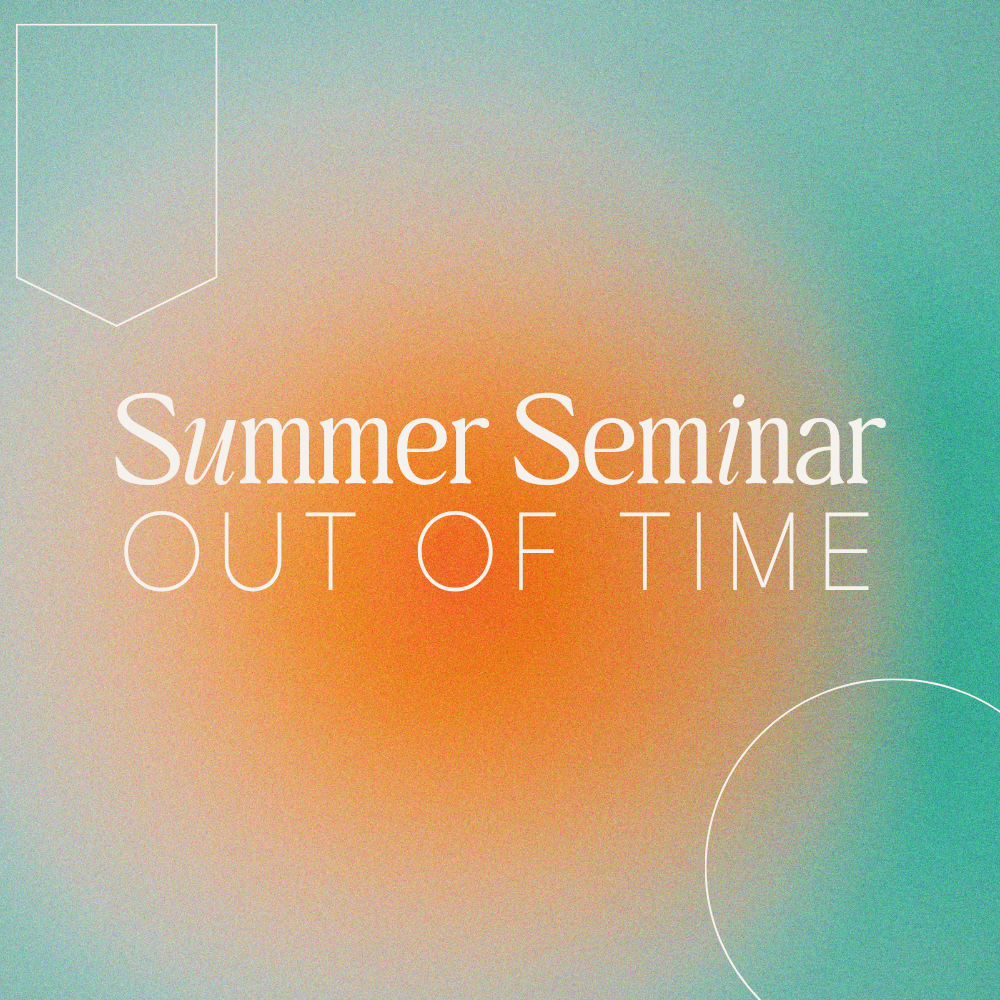
Summer Seminar is back!
Summer Seminar is a chill reading and discussion group where there’s no such thing as being behind and no right answers.
Join me for 8 weeks of speculative fiction and critical (re)thinking. This year, our theme is “Out of Time,” reflecting on time, solitude, and hope. Learn more and register.