The Desire to Deviate
“Every once in a while there's a little trouble with cooperation, but it's easily taken care of. After today he'll never desire to deviate again.”
— Charles Wallace in A Wrinkle in Time
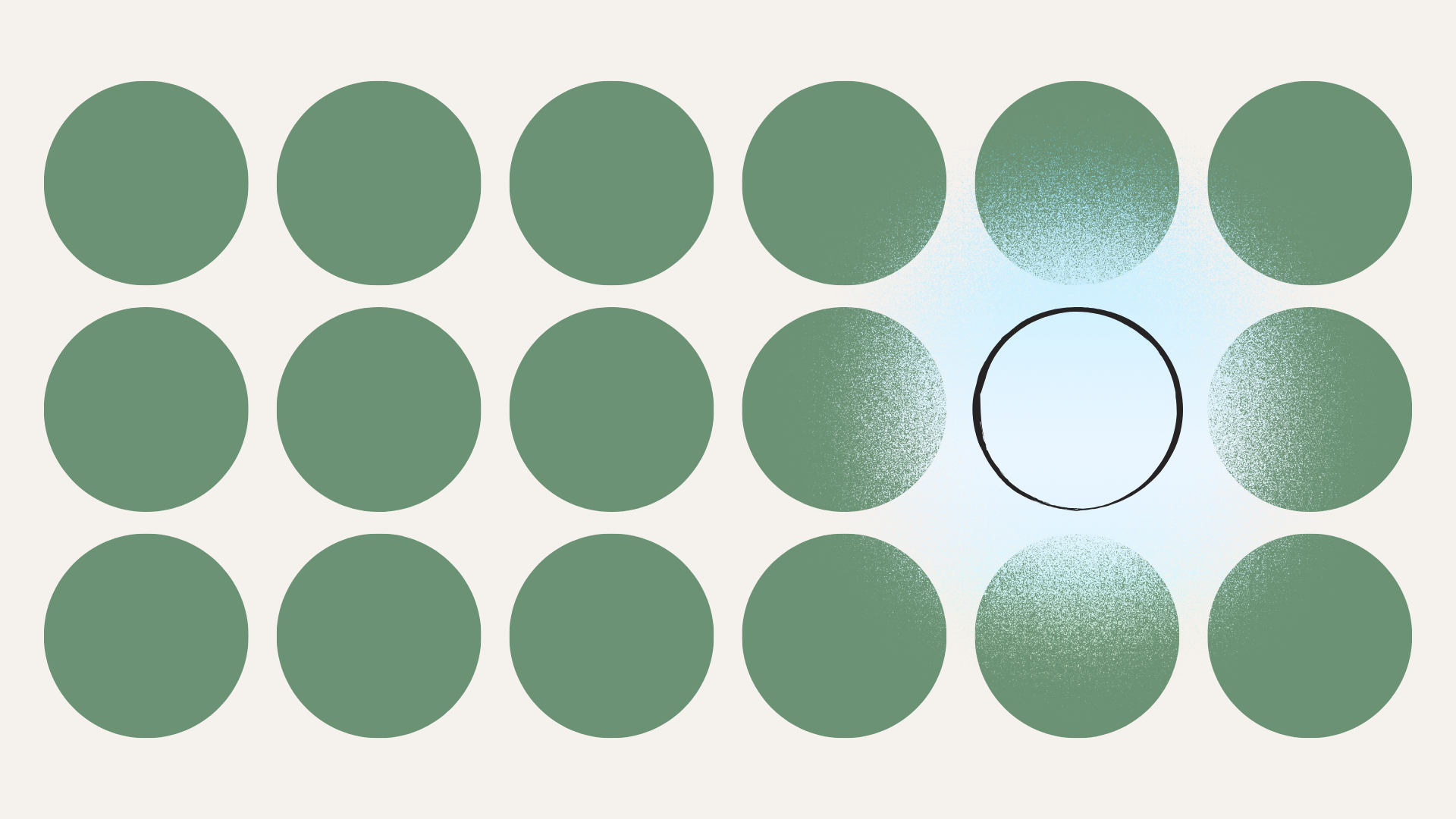
In the classic novel, A Wrinkle in Time(1962), Meg searches for her missing father with her brother Charles Wallace and her friend Calvin on the planet Camazotz. When they arrive, they discover a world that looks much like their own—save that everything in it is completely uniform. The houses, the driveways, the streets: they all look the same.
There are even standardized children playing in front of each house. Boys bouncing balls; girls skipping rope. All in sync with each other.
As Meg, Charles Wallace, and Calvin observe all this, the children simultaneously turn to go inside—except for one boy who loses control of his ball. His mother fearfully rushes to hide the so-called Aberration and then promptly denies it occurred when the trio tries to return the ball.
Meg, Charles Wallace, and Calvin quickly discover that the reason for the extreme synchronicity and the anxiety it provokes when interrupted is that the planet is overseen by an entity known simply as IT: "IT was a brain. A disembodied brain. An oversized brain, just enough larger than normal to be completely revolting and terrifying."
IT exercises control over the population not through violence but through coordination and conformity:
"Why should you wish to fight someone who is here only to save you pain and trouble? For you, as well as for the rest of all the happy, useful people on this plant, I, in my own strength, am willing to assume all the pain, all the responsibility, all the burdens of thought and decision."
IT counts on the population of Camazotz to trade frustration and friction for the simplicity of acquiescence to authority.
Mid-20th-century stories like A Wrinkle in Time tapped into lingering fear of fascism and ongoing anxiety about Soviet communism—both systems that aimed to shrink the acceptable range of human expression so as to more easily manage (or control) a population with far fewer pesky variables. Like all of Madeleine L’Engle’s books, Wrinkle doesn’t shy away from the pain and mess of reality. L’Engle achieves this by engaging a sense of hope, not that everything will turn out to be okay but that people who are alive to care, creativity, and critical thinking can act to make things better.
When I’m working at my desk, I have several copies of A Wrinkle in Time at my back, just over my left shoulder. Next to them is the rest of the Time Quartet and a signed copy of Troubling a Star. When I was but a tween, I read through all of L’Engle’s fiction, including her adult novels. My memories of all but the Time Quartet are pretty fuzzy. But what lingers for me is L’Engle’s embrace of both/and. She wrote both as a Christian and as someone profoundly interested in science (not a true contradiction, of course, but a persistent stereotype nonetheless). She was interested in independent and, as they say, “strong-willed” girls and women who were also deeply invested in family (same as above).
The heart of her novels is a desire to deviate from norms, to widen the aperture of potential. Fitting for a book, as her granddaughter writes in the afterword to the 50th anniversary edition, that “didn’t quite fit into any of the usual categories.”
More than 60 years after Wrinkle’s publication, we are again confronted with encroaching authoritarianism. Yes, authoritarianism of the government sort. But also authoritarianism of the technological sort—a much more clever and sneakier form.
If You Conform
Nilay Patel, the editor-in-chief of The Verge, said so quite plainly on a recent episode of The Vergecast. He and co-host David Pierce discussed recent rollouts of AI products—one of which, Gemini Spark, David had just had an uncanny experience with.
The show’s general stance to this point is that AI consumer products just don't work very well. They ask too much of us collectively and individually for far too little utility. But David’s experience had alerted him to some big improvements: “I hate to be the bearer of bad news,” he said, “but like the tech kind of works now.”
In response, Patel offered a caveat. It works for work. More specifically, it works for tasks that involve information that can be easily sorted into databases. That is, granted, a lot of tasks with a vast economic scope. However, Patel added, “It works if you conform to how it wants you to operate.” Not a problem for “work” stuff, as corporations are happy to change processes, information architecture, and procedures to gain efficiencies that result in profit.
But for life stuff? Conforming has the same appeal today that it did in 1962 (probably less).
Patel continued:
“…making people's lives feel like work makes for horrible consumer products. These consumer products are not anywhere close to good enough, because all of them are in the framework of what if more of your life looked like using the computer at work.”
I gave a hearty “woot” and punched the air while listening on my morning walk.
A few weeks ago, while researching the actual impact of AI tools on productivity, I came across a study that found people were getting more done at home thanks to AI. “AI’s big productivity boost? It’s happening from the sofa,” the headline publicizing the research declared.
Using data produced from web browsing, analysis showed that people could accomplish “digital chores” (e.g., paying bills, shopping for household basics, job hunting, etc.) far more efficiently by leveraging generative AI. Researchers found “strong evidence to suggest that the home is where AI so far is delivering the biggest productivity gains.” The analysis also found that time freed up in the process was being reallocated to watching TV or feeds and spending time with friends and family.
What’s more, one of the lead researchers, Michael Blank, told Krysten Crawford at the Stanford Report that the optimistic view (“glass-half-full view”) on what the study found was that people were able to be “more efficient at tedious home tasks.” On the other hand, the “glass-half-empty view is that they don’t seem to be spending their additional free time on developing new skills or other ‘human capital‘ investments shown to improve standards of living.”
Yikes. That’s not just glass-half-empty; that’s dystopian.
If the best-case scenario is that we use AI tools to make “human capital investments” in our free time, we’ve already lost. In the 21st-century economy, the thing that improves standards of living is less work, not more work. More meaning, more varied forms of human expression, more vibrant cultural engagement, more friends, more family, more community—and less conformity. That’s what improves standards of living.
Filling free time with more work doesn’t improve standards of living. It hastens the standardization of living.
The Standardization of Living
And it’s that standardization that reeks of authoritarianism. Democracy, as a system, assumes disagreement and offers structured ways to parse that disagreement, make policy based on majority opinions, and protect minority opinions from unnecessary encroachment. It's the blend of aims that offers stability amid differences of perspective. Authoritarianism "works" by standardizing as much of life and work as possible. Those who don't conform to standards are pariahs.
In The Origins of Totalitarianism, Hannah Arendt describes this process not unlike L'Engle's IT:
“Totalitarianism strives not toward despotic rule over men, but toward a system in which men are superfluous. Total power can be achieved and safeguarded only in a world of conditioned reflexes, of marionettes without the slightest trace of spontaneity.”
As I said, we've seen (and continue to see) political authoritarianism on the upswell at home and abroad. And while frightening and infuriating, this style of authoritarianism provides a clear focus for resistance. We have a playbook for fighting back against it. Technological authoritarianism is much more diffuse. The “conditioned reflexes” it shapes get cloaked by the spectacle of entertainment and the impulse toward quick fixes. We become marionettes whose strings cannot be cut because they cannot be seen.
Software works because it assumes a certain level of sameness. By reducing possible inputs, outputs get easier to program. Learning how to use an app is really learning to limit behavior to a predictable set of actions.
We either accept the limitations of an app because the increased utility is a trade-off we’re willing to make, or we find an app that is a better fit for the particular set of behaviors we foresee doing. I’ve ranted about productivity software many, many times before—and I can come up with all sorts of reasons that I tend to hate those apps. But those reasons all pretty much boil down to forcing me into a set of expected behaviors that don’t jive with how I work.
That doesn’t mean the software is bad, just that I’m not overly willing to conform to it.
One reason there's so much competition in the productivity app space is that there are so many sets of behaviors teams need them for. Each set of behaviors is a market opportunity. Once a business determines the set of behaviors it wants to manage, it can choose software and train the team to work within that set of behaviors. In short order, everyone’s work is recalibrated to the standard set of behaviors the chosen software is designed for.
If your business runs on Asana, everyone on your team is limited (to one degree or another) to the standardized behaviors that Asana was built for. If your business runs on ClickUp, or Monday, or Todoist, same thing. By aligning each team member’s potential actions and making behavior more predictable, workers become easier to manage.
Software optimizes our experience by training us to become more predictable.
AI boosters claim that the tools they’re developing make it possible to interact with software in more organic, “natural” ways. But really, the industry has simply gotten better at designing tools that narrow and flatten our choices without revealing the true outcome. We lose the desire to deviate because deviation is frustrating and disruptive.
This is not to say that the broligarchs are sitting in their glass-walled offices (or doomsday bunkers) and intentionally designing systems to suppress the masses. It’s just that all of the mechanics and incentives of the system point them toward engineering predictability into their products.
Predictable constituents are easier to pander to. Predictable consumers are easier to market to. Predictable workers are easier to extract from.
Historian Timothy Snyder, building on Arendt, argues that “unpredictability” is one of the essential components of freedom. “Free people are predictable to themselves but unpredictable to authorities and machines,” he explains. “Unfree people are unpredictable to themselves and predictable to rulers.” We might try swapping out the words to match the tech context: Free people are predictable to themselves but unpredictable to software. Unfree people are unpredictable to themselves and predictable to software. Free people are unpredictable to chatbots. Unfree people are predictable to chatbots. Free people are unpredictable to algorithms. Unfree people are predictable to algorithms.
It’s a stretch. But I don’t think it’s a big one.
And maybe you’re thinking that algorithms, chatbots, and various apps have gotten so good. But I ask you to consider what exactly they’ve gotten so good at. Is it true that they’ve become better able to anticipate your needs or deliver useful “advice?” Or is it that the systems have over time, with greater levels of surveillance, and through countless repetitions, trained you to narrow yourself down to fit into a mold they can “predict?”
Madeleine L’Engle is not the only science fiction writer to consider the effects of conformity and its connection to authoritarianism. In fact, there are far too many for me to name here. But another one of my favorites, Ursula K. Le Guin, had this to say in a lecture almost 25 years ago:
“In our time of huge populations exposed continuously to reproduced voices, images, and words used for commercial and political profit, there are too many people who want to and can invent us, own us, shape and control us through seductive and powerful media.”
Le Guin’s stories often revolve around the theme of being trapped in an unnecessarily constraining system—often capitalism, colonialism, or patriarchy. Her protagonists are the curious. They are the ones who chafe against conformity even before they have a name for their struggle. They’re seekers who seek answers beyond what institutions and authorities provide. They overcome oppression and rigid norms, sometimes in small ways, other times in big ways, by exercising their desire to deviate.
Le Guin encourages us to "learn how to invent our lives, make them up, imagine them.” And she acknowledges that we need “to be taught these skills.” We need guides. “Without them, our lives get made up for us by other people."
Meg’s guides in Wrinkle are Mrs. Whatsit, Mrs. Which, and Mrs. Who, along with Aunt Beast and the Happy Medium. The way out from IT’s control and off of Camazotz is double-sided; Mrs. Whatsit gives Meg the gift of her faults, and Mrs. Which tells Meg that she has something that IT does not.
IT tries to bring Meg into the numbness IT uses to subdue the people of Camazotz. As Meg stands before the oversized, revolting, disembodied brain and resists IT’s control, she battles back in two corresponding ways. One is her anger—her anger at what it has done to her brother, to her father, to the whole world of Camazotz. Anger that she resists allowing to curdle into hatred because, at the same time, she realizes that what she has that IT doesn't is love.
It's that immensity of feeling and the substance of her presence that allows Meg to resist and escape with her family. Anger and love create the desire to deviate.
Meg's incandescence is what has made this story so impactful to so many people for so many years. And I think that incandescence is indicative of something else that Hannah Arendt argues in Origins, which connects directly to what Patel was talking about: turning more and more of our lives into work.
Arendt suggests that the numbness and the quiescence, and with it, the ability to tolerate oppression, occur when our "most elementary form of human creativity" is destroyed. That is, she says, "the capacity to add something of one's own to the common world." This, she continues, occurs “in a world whose chief values are dictated by labor, that is, where all human activities have been transformed into laboring.”
When technology makes everything seamless and automated in the name of productivity, choosing to feel, to be effortful, to be present to our own curiosity and creative drive is an act of deviation. It allows us to order off the limited menu of options for our next act.
So how then do we cultivate the desire to deviate, remain unpredictable, and preserve our capacity to contribute something of our own to the world?
I have three suggestions, though these are hardly exhaustive.
Embrace friction when you can.
Just because AI can do it doesn't mean it should. Just because something can be automated doesn't mean it should. Just because you can throw money at a problem to make it go away or get what you want doesn't mean you should.
You already know this. But the effortful, friction-embracing life can feel like an all-or-nothing decision—and it's often presented that way in the media. Either you bake sourdough from scratch, or you might as well take every shortcut available to you.
This is a false dichotomy. Choose friction when you can and aim to reduce friction when you can't. By all means, take some shortcuts on the things that don't matter to you! But beware that you're doing it.
Question what’s presented to you.
One of the broligarchy's greatest accomplishments is hiding the source behind what's on offer.
"How did this get here?" and "Why is it being presented to me?" are critical questions for today's media landscape. Whether it's an ad or a funny video or a suggested account, there is a reason it is showing up in front of you. Contextualizing that suggestion creates a framework we can use to deviate from the path of least resistance.
Let answers be ambiguous.
Finally, tolerance for ambiguity is key to cultivating a desire to deviate. Certainty narrows our options. That's not always a bad thing, as Snyder points out. If I'm certain of my values, for example, I am predictable to myself but not to external forces.
But the language and tone of certainty are baked into the tech we use, prioritized by elected leaders, and deployed in sales copy—all of which want to narrow our options to whatever the preferred next step is. A robust skepticism of certainty when originating from actors with ulterior motives creates more space for us to act according to our own interests and those of the community.
Last Thing
I regularly write about AI (or more specifically, the AI industry) because it's indicative of so much that scaffolds our economy and society. It's true that computer science is doing some pretty novel stuff right now. But the larger sweep of the AI industry's force is nothing new. It's just a new package for the same methods of accumulation, control, and power.
The desire to deviate is just as old.
The desire to deviate will never be found at the end of an algorithm or the output of AI based on probabilistic (read: predictive) reasoning. Our creative contributions to the common world may be technologically assisted, but they'll never be technologically created.
These are abstract ideas, but they have material implications. Go do something unpredictable.
Summer Seminar
✳︎
Out of Time
✳︎
Summer Seminar ✳︎ Out of Time ✳︎
Summer Seminar is back!
Join me for 8 weeks of speculative fiction and critical (re)thinking. This year, our theme is “Out of Time,” reflecting on time, solitude, and hope. Learn more and register.