Rethinking Higher Education for the 21st-Century Economy
with Lauren Lassabe Shepherd

It's no secret that one of my, let's say, special interests is higher education.
The reasons for this are at least threefold. First, I have a kid heading off to college next year. Second, I have past regrets and future fantasies about the academy. And third, the world of work and the realm of education overlap in myriad ways.
Work and education have always had a close relationship. Access to education influences access to different types of work. New forms of work influence how we organize and deliver education. Apprenticeship, internship, fellowship, residency—these are all concepts in which education and work are woven together.
In the 21st century, the relationship between work and education is under the same economic, social, and political pressures as the rest of society. Both for those working in education and for those being educated, the classroom is a site of discipline and control. Students learn what fields are acceptable, what trade-offs will—hopefully—make their lives a little easier, what rung on the ladder of the social order they’re allowed to occupy. Instructors learn to stay in their lane—unless of course, their lane is in one of the unacceptable fields or the result of the “wrong” trade-off. We take the lessons we learn in education—specifically, the ones concerned with discipline and control—and apply them to work.
Today, there is more access to higher education than at any time in history. At least theoretically. There are thousands of colleges and universities of varying types in the United States. If you’ve got the time and money, there is an institution at which you can enroll and earn a degree. Of course, that “time and money,” part is a Big If.
Access to higher education in the US is contingent on one’s ability to cobble together the necessary resources. And that means that access to many forms of work are contingent on the same. This overlapping contingency is central to how we experience class and social hierarchy today.
I decided to put my interviewer hat back on so that I could talk about work and higher ed—that is, both working in higher ed and the ways that higher ed and work generally intersect—with someone who has first-hand experience and professional insight. Dr. Lauren Lassabe Shepherd is a historian of higher education and the host of the American Campus Podcast.
Our conversation ranges from big picture shifts in higher education over the last half century to the personal fall out of these changes to the potential for engaging with a renewed vision for intellectual exploration outside of the institution. The connections to rethinking work and leadership in the 21st-century economy are plentiful.
I get a bit obsessed with higher education because it feels like ground zero for both the top-down pressure on work and the bottom-up potential for pushing back. Here is where we train up citizens, and here is where we celebrate curiosity about the past, present, and future. From graduate student labor unions to campus protests, incredible things can happen on the American campus that will impact life off the campus in important ways.
The transcript of this conversation has been edited for length and clarity.
Tara: What drew you to studying and theorizing on the American campus and higher education?
Lauren: I'm trained as a historian of education, but most ed historians look at K-12. I'm also interested in K-12 too, as part of education more broadly, but what particularly interests me about colleges and universities in the US is their relationship with all the other things I'm interested in, like class, and state power, and knowledge-making and US hegemony around the world.
I didn't always approach the study of higher education critically, nor was I trained to. My own coursework was very neoliberal. It was quantitative and I think American Campus listeners would probably be shocked to know that I actually have a minor in quantitative institutional research.
But the critical historical lens is something that I have developed over time. My dissertation was actually on how conservative students organized on the campus in the 1960s in the book that came out of that, Resistance From the Right, was about right-wing attacks on higher education. So in some sense, I sort of started off taking a defensive stand protecting higher ed from attacks from the right. But then over time, I have become much more critical from the left about the exploitative nature of our universities, historically and in the present.
So, it's just my own personal quest. I want to understand this cultural and state institution better.
Tara: What did higher education mean for you as a child or a younger student? What did you expect from college, and how have those expectations evolved?
Lauren: I think we're probably both of Millennial/Gen X era, so I understood that you have to go to college if you want a middle-class job. I definitely grew up knowing that I was going to college. I got in trouble if I brought home anything less than an A in K-12.
So going to college was not even a question. Both my parents did go to college. They both have bachelor's degrees. My mom actually has a master's degree because she was a K-12 teacher. And they all went to the same institution, which is also where I went.
I majored in history, decided I was going to be a teacher just like my mom. I taught high school and middle school for a long time, and then kept working on my master's and then PhD.
But I will say one thing I've realized now as an adult that I didn't know, when I was younger, is that you can actually go anywhere that will accept you for college. In my mind, you needed to go in-state because that's what you did. You went to your state schools.
There's a lot of literature on the way that Hollywood movies portray going to college and how that shapes your understanding of how going to college works and where you get to go.
Tara: Well you mentioned the big N-word: neoliberalism. One of the things I clocked early listening to your show is that the way you say that word implies a lot of feelings.
Lauren: You can hear the disdain.
Tara: Yes, I can hear the disdain. I am here for it. I love it.
Okay, what is neoliberalism? Briefly, it’s an economic and political framework that prioritizes free markets as the most efficient and effective means of meeting needs. The logic of neoliberalism has led to the privatization of formerly public services, the financialization of many sectors of the economy, business-friendly tax codes, and the deregulation of industry.
Reasonable people can disagree about whether those effects are good or bad. Though if you think they’re good, I think you’re wrong! And liberals and conservatives alike have supported neoliberal policies over the last 50 years.
Nancy Fraser has a really interesting take on this in her book, The Old is Dying and the New Cannot Be Born. She differentiates between reactionary neoliberalism and progressive neoliberalism. Now this might sound like I've further complicated the definition of a word that gets bandied about on the regular. But the distinction is instructive.
Reactionary neoliberalism is centered in reactionary politics, the kind that would see the benefits of capitalism and the state flow to those who have historically been on the top of the social order: white, Christian, wealthy men. This is the kind of neoliberalism we associate with Reagan and Trump in his first term.
Progressive neoliberalism—think Clinton and Obama—seeks to recognize groups that have been historically on the bottom of the social order: women, racialized minorities, immigrants, LGBTQ folks, and others. The goal in progressive neoliberalism is to make sure people in these groups have a fair shot at attaining the benefits of capitalism and the state.
But, as Fraser notes, both sides of the spectrum follow the same framework when it comes to distribution of resources. Both the left and the right's version of neoliberalism have sought to privatize public goods, unleash entrepreneurial innovation, and free capital through deregulation and financialization. The distributive logic of neoliberalism is, for example, how we end up with the Affordable Care Act instead of single-payer health insurance—the government gets into the business of creating or supercharging markets instead of providing efficient and cost-effective solutions to the public.
Or, as Fraser put it:
"[Progressive ideas] were interpreted in a specific, limited way that was fully compatible with the Goldman Sachsification of the US economy: Protecting the environment meant carbon trading. Promoting home ownership meant bundling subprime loans together and reselling them as mortgage-backed securities. Equality meant meritocracy."
If we had to choose one sector in which the effects of neoliberalism were most acutely felt in the US, it would be healthcare. But I'd put higher ed in second place.
Tara: How has neoliberalism changed what we think of as higher education or what its purpose is? And now neoliberalism changed the university itself?
Lauren: Yeah. I mean, like, gosh, how didn't it?
There are some scholars who say that neoliberalism, starting in the 1970s, unmade what was becoming a Golden Era of higher education. After the end of World War II until about the Carter administration, the federal government was just like giving blank checks to research universities and the Ivies. They were getting hundreds of millions of dollars each semester.
Access was growing. More people were enrolling.
So that's this sort of Golden Age that we have in the historiography of the academy. We can talk about how the Golden Era was only a Golden Era for white men and US citizens. But there was much expansion.
And then starting in about the 1970s, higher education funding at the federal and state levels began a long decline. Looking historically, we can say that neoliberalism unmade this great thing that was taking off. But if we really zoom out in history, the so-called decline is actually just a return to the mean.
What was exceptional was the Golden Era. So all those funding cuts that began with Carter, then really took off under Reagan, and sort of exploded under Obama, are making colleges and universities look like they looked before, which is a lack of government funding, especially in the public sphere, that affects things like faculty pay.
One new thing that neoliberalism brought that didn't exist before the Golden Era is casualization. That is gig work, like I'm sure many of your listeners are very familiar with. So we have people with PhDs teaching one, two, or even maybe eight courses a year at different institutions, but being paid as an independent contractor, without benefits like healthcare or retirement savings, or even the ability to sit on faculty governing boards.
We also see lots of student debt. It's all the things that those of us who work in the academy toil with today. These problems that feel new, like they are the results of neoliberalism, are just things that we saw before. The only real new thing is the casualization of labor.
Let’s pause on labor casualization for a moment. Whether you know the term or not, it’s a concept you’re definitely familiar with. Casualization, as well as its more tech-mediated cousin “gigification,” is the process by which full-time jobs and more formal work relationships are converted into more casual contract relationships.
Casualization is one of the top pressures on American scholarship today. You know, in addition to ideological attacks on truth, critical thinking, and science. Today’s colleges and universities are heavily reliant on adjunct faculty and graduate student labor.
In 1987, more than half of college faculty in the US were full-time, long-term instructors. As of 2021, only a third of faculty are full-time, with two-thirds being contingent workers. Similarly, “fewer than one in four faculty members holds a tenured full-time position, down from 39 percent in 1987,” according to Anna Conway and Thomas Tobin at Inside Higher Ed.
Adjunct faculty, who are contracted to teach courses at a flat-rate, often earn less than $3,000 per course. A full-time equivalent course load at that rate would deliver an annual income of just $24,000. No health insurance. No paid-time off. No retirement savings. A survey from the American Federation of Teachers found that 40% of contingent faculty had trouble meeting basic expenses. A third couldn’t clear the poverty line on their earnings from teaching. A quarter depended on government assistance such as food stamps and Medicaid. This survey was completed in 2019—pre-pandemic—and by all accounts on the ground, the situation has gotten much worse in the last five years.
Gila Berryman wrote about the "secret lives of adjunct professors" for Elle. "Most adjuncts have to hustle to survive," she explains. As an adjunct, the most Berryman ever made in a year was just $23,000—an amount she reached teaching full-time during the school year, plus summer classes, plus 12 hours per week of tutoring. She helped make ends meet by housesitting in the summer to save on rent and utilities. Not surprisingly, Berryman burnt out.
Women and people from marginalized backgrounds are overrepresented in the ranks of contingent faculty. Berryman, who describes herself as a "butch-of-center Black woman," notes that her predominantly Black and brown students saw her as someone who could be their neighbor, someone they could trust. She writes:
"Students need instructors they can relate to, and who can relate to them; people of color, working class people, and openly LGBTQ people, so they don’t feel alienated within a strange and vast institutional system. But if the policies that created the deplorable treatment of adjuncts persists, minority instructors like me will continue to leave academia."
The fact that labor casualization is a process that disproportionately affects women and minorities is reason enough to significantly limit its scope. So is the poverty-level wage. So is the lack of a safety net and health insurance and professional opportunities. By the way, if these downsides sound familiar, it's because adjunct labor and the workers who do it have a lot in common with contracted labor of all kinds—including the kind I do and the kind you may very well do.
Tara: In addition to casualization, another aspect that seems new is the understanding that you mentioned earlier: you have to get a degree to get a middle-class job. Of course, that was only true for a time, too. Today, a degree is no guarantee of a middle-class job, but you “have to” try to have a shot at that kind of life, often accumulating staggering debt in the process.
What do you see as the repercussions of those two pieces of the neoliberal project coming together for students, faculty, and the purpose of the university as a whole?
Lauren: The largest effect is the idea that education is no longer a public good. It's a private good. It's an investment that an individual makes in their career. And it's also what you need for just basic life support. Things like your healthcare and your retirement are tied to full-time employment.
So the message evolved: You have to go to college if you want a middle-class standard of living. And, you have to pay for it on your own. The federal government is not going to support the college with all of the things it needs for its bottom line, so your tuition is going to have to make up that difference, which you can borrow, and graduate, and be saddled with debt. But what was your other option? And of course, that's not to say there aren't other options, but that’s the message.
So how does that change our relationship with higher education? I fundamentally believe higher education, education that extends past K-12, should be open access, and it should be free. Anybody who wants to learn for the sake of learning should be able to do it.
Does that need to happen in a college or university setting? Not always. I mean, we have public libraries. But there's only so many hours in a day. People do need to work, and people want to work, and they also want to learn.
The American grindset that says we all need to get in at minimum 40 hours a week doesn't leave much time for curiosity, and creativity, and entertainment, and leisure, and all of the other things I think college is great for.
I don't think learning needs to be about productivity. It can, and it definitely lends itself to innovation and creating things with financial value. But the way that we as Americans think about college today is usually with a “use model.” In other words, I need to be trained in something for a job, and not just learning for the sake of learning.
Tara: My daughter's going off to college next year, and so we've been talking about what she might want to major in. And she doesn't quite know yet.
She's getting the message from well-meaning people in her life that she should base her major on what she wants to do for work. And I'm telling her the exact opposite. Who knows what jobs will be available five years from now? Major in something you're interested in, pick something because it sounds cool.
How has the narrative shift from ‘education is good’ to ‘education is good job training’ impacted the institutions and the systems within higher ed?
Lauren: That's its own story, and it's as much a neoliberalism story as it is a culture war story.
For the first 250 years of higher education in the US up until the GI Bill, right after World War II, most people who went to college were Christian white men. So if you went to the best, most well-known, most resourced institutions, you were most likely a young white man, from a Protestant background, with lots of social connections.
As soon as college becomes more accessible, people start limiting what gets taught there and what the purpose of seeking higher education is.
A lot of this also has to do with the 1960s and the campus wars. Future Supreme Court Justice Lewis F. Powell Jr. writes the infamous Powell Memo that says a good way to get these radicals to stop protesting is to make them pay for college and/or face punishments like expulsion. So Ronald Reagan, as governor of California, which had a very low-cost model at the time, took this idea and runs with it.
And it worked. When you start punishing student dissenters, it works. Because these are, as students, often people with the most to lose.
And so, the Powell Memo is a big inflection point there, but this is also happening in the context of neoliberalism. All these things are mixed up together. So the idea becomes that if you go to college, it should be for something.
Get your degree, get out, don't protest, don't use any of the critical thinking skills that you're being taught. Think about getting a job.
Tara: I had never heard that making college more accessible also helped to limit what was being taught.
Lauren: Not at all schools. So, at the best-resourced schools, like the Ivies, you can still go pursue a degree in art history because the idea is you won't be working anyway. You've got a trust fund somewhere. This is for your leisure, your pleasure, and your understanding of appreciation of art and culture.
That's the sort of thing that I think should be available to everyone, totally separate and apart from what someone's labor is during the day.
So you can still pursue that at an exorbitant cost. But your state public universities and your R1 research institutions, they're like, “Stem! Stem! Stem!”
Tara: Okay, post great recession, we're sort of exiting the neoliberal era, and that seems to coincide with some, if not new, some fresh attacks on higher education. I'm curious how contemporary attacks differ from or are similar to those of the end of the 20th century.
Lauren: Yeah, there's a lot of parallels there. The language has changed, but the grievances haven't. So, for example, when we hear of “wokeness” today or a few years ago, Chris Rufo’s war on critical race theory and DEI, that's just the 2020s version of political correctness. It's the 1970s and eighties version of affirmative action panics.
So these things follow a very identifiable playbook. To your question about how it materially impacts students, I'll include faculty and staff, too. Because the war on DEI is essentially just a war on non-white people on campus, as well as research about non-white people or critical research on whiteness.
It’s not even just race. We see this in gender and sexuality studies, too. There’s been a silencing of faculty, but not evenly. There are some states that are doing a really good job of protecting their faculty and AAUP chapters that are really like standing up for academic freedom.
In red states, like Texas which is in the news all of the time, there are material effects for workers on campus: if you work in a DEI center, if you have lost your job, or if you've been transferred to a different department to do something else. We can kind of feel this sort of like chilling across institutions where people in red states are less able to be open. Nobody wants to walk around with a target on their back, especially if you're a contingent employee who can be fired at will.
Even if you're on the tenure track and haven't reached tenure yet, many of those faculty are scared and want to toe the line, even if it goes against their conscience. Because, as we were talking about a second ago, the state provides no social safety net.
Tara: With regard to the social safety net piece, it seems that the mindset of someone wanting to work as a faculty member today and the mindset of someone who's starting a small business have to be pretty similar. You have to be thinking about how you are protecting yourself, taking care of yourself. There are these immense privileges that come with the title or the status, you know, professor or entrepreneur, but at the end of the day, there are really perverse incentives around how you conduct yourself, how you spend your time, just the precarity of it all.
Lauren: We all live within capitalism and what it will and won't allow us to do. I think you just have to be able to sleep with yourself at night, but at the same time, you also have to pay your rent to be able to have somewhere to sleep at night.
Tara: Absolutely. Well, on that note, when I heard your conversation with Bryan Alexander about the peak and the decline of higher ed, my heart stopped when you told him that his idea of what higher ed was sounded really great, but that you hadn’t ever experienced it. I thought I heard some pain in your voice about what the promise of this career track was and how it had not fulfilled itself for you or many of your cohort.
It hit me really hard because going to graduate school and eventually becoming a professor was my dream. But despite being accepted to my top-choice, fully funded master’s program, I had a breakdown after undergrad and got really cold feet two weeks before I was supposed to leave. A substantial part of my breakdown was that I was worried that I was going to go to grad school, do all these things, get into a bunch of debt, and never be able to get a professorship. I still dream of it to this day, and I'm almost 44.
So all of that to say, I would love to hear more about your personal journey, from your PhD program to the career you envisioned to the work you’re actually doing today.
Lauren: I'll totally share my personal story, and I can also contextualize myself within a national narrative.
Bryan Alexander is a futurist who studies higher education. Bryan argues that the peak of higher ed was in 2011 or 2012, and that we've been in a decline since then.
So I finished undergrad in 2011, so I see myself in this wave. Of my graduate school cohort, two of us got jobs after finishing our PhDs, and neither of us was in a faculty position.
I defended my dissertation in February 2020.
Tara: Oh geez, no.
Lauren: Yeah. So I thought I’ll take any job I can get. Because nationwide, everyone was on a hiring freeze. I applied for this position at the University of New Orleans, and I was sort of a Frankenstein candidate, but like the perfect person for the job.
This job was a low-level admin position, but it came with the chance to teach.
I was sort of this perfect interdisciplinary mix, because I was trained in ed studies but had quantitative and historical research backgrounds. So not only was I teaching people in the ed studies department, but I was also teaching students in psychology, and sociology, and counseling.
I felt like I was far afield from my disciplinary expertise. This is what they needed: one person who could do 12 jobs. So that's how I got a job. But again, it was not a faculty position. The other woman that I graduated with also got a job in New Orleans. She got a job in student affairs at Tulane.
Everybody else ended up starting small businesses. One is a wedding photographer, incredibly successful. My best friend Kate has a bakery that's been really successful. And Kate's interesting because she actually wrote the first three chapters of her dissertation, and the reason she couldn't do her last two, which are like gathering data, conducting the research, and analyzing it, is because of COVID.
So she just ended up dropping out and I'm like, “Kate, you finished PhD coursework. You have three out of five chapters!” And she says, “It's not worth it. Why would I spend the money to write the last two chapters of a dissertation for a degree I'm not going to use?”
She's good with her choice. And she is much less stressed than anybody who’s working in higher ed right now.
So now, the rest of my story gets much worse. I'm teaching at UNO; I've been there for five years. And they just announced that UNO is closing. The writing was kind of on the wall. We're all watching this sinking ship. They called for voluntary furloughs. Lots of us took the furlough. And so now I am just an independent an independent scholar.
But they just announced that UNO is going to be merging with LSU.
So it's going to be an LSU satellite campus. So if you take the cynical view, which I always do, it's like, oh, that was the plan. They were trying to downsize so they didn't have to go through the messiness of HR before announcing that.
Tara: That doesn't seem cynical to me at all. I mean, companies do that all the time. Why would academia be any different? You mentioned there's you, and there's your cohort, and then there's the national trends around turning graduate studies into careers in the academy.
What are those trends?
Lauren: We could think about all of this under the banner of the casualization of academic labor, the gig economy. At colleges and universities, when they're hiring a department may not be able to afford three new faculty lines. So instead they'll hire an adjunct, someone to teach one or two classes a semester, and they don't have to provide any benefits because it's part-time work. That has become the norm in the humanities and social sciences since about 2008, since the Great Recession.
I don't mean to say that you can't get a tenure-track job; they still exist, especially in the hard sciences. But if you are trained as I am in the social sciences or if you are a pure historian or if you have a PhD in English literature, I mean, it's just hard to get a job.
Tara: Or, religious studies like me.
Lauren: Exactly.
Tara: I'm not saying I was wrong about not expecting a job out of grad school. I just get sad about it.
Lauren: It's a fair regret. I did an episode called “How to get a job at Harvard in 1860,” You just had to be a man; you didn’t need a PhD because it was a newly invented degree that hadn’t quite made it to the US yet. You just had to show up and be like, “Would you like me to teach? Because I'll do it.” And then you're a professor for your entire life, and you have like all this respect and esteem for your name.
What a lot of American academics are doing, especially if they have a PhD from an elite institution, is going overseas to places that are still hiring. Although I will say, I have colleagues in France who just shared that they're basically following the American model.
It's neoliberalism all the way down. It's coming for them too, but it hasn't quite hit as hard as we're experiencing here.
Tara: Always great to be on the cutting edge. In that same conversation with Bryan Alexander, you mentioned favoring a “managed decline” for the current higher ed system. What would that look like? And what’s your vision for education beyond K-12?
Lauren: Well, it could be very easy. It could be as easy as going to your local public library and just reading what's on the shelves, or just getting on the computer and searching the databases. But it's also as simple as forming a study group.
So I have a couple of writing groups that I'm part of. And one of them, when we set it up, we decided that it wasn’t only going to be a writing group. It would also be a “thinking group.” We meet once a month, and we’reall are 20th-century historians, but we study different things. Whoever's turn it is that month will submit something that they've written. So we'll all read, comment, and chit-chat about that for the first hour.
And then for the second hour, we all read a common book that that person picked. Like I just had to read a book on religious dispensationalism, which I knew nothing about. But it's great because we're all operating within the 20th century, and so it gets us out of our genre silos.
So that thinking group is an academic seminar. We all happen to have PhDs and be trained historians, but you don't need that. It's no different than a Bible study. It can be a book club. It's just learning for the sake of learning.
It doesn't have to be nonfiction. You could read a novel, which is what typically happens at book clubs, or like a movie club, just get together with other people and talk and discuss and expand your own thinking. And make friends in the process, and bond with other humans.
That's the part of higher education that I want to be accessible to everyone at no cost or extremely low cost. You don't need a university to do that. You don't need a campus. Although if you're in the sciences, I'm not sure how you would replicate a lab in your home. That's a little bit trickier, but this model is very easy for someone in the humanities.
In terms of managed decline, I’m not a burn-it-all-down, the academy is evil, we need to do away with it kind of person. It does some really bad stuff, but there are often the best of intentions.
So my idea of managed decline is slowly unraveling the things that are bad, the things that do harm, to get back to the core of what learning is, what knowledge production is, what community between scholars or people who are interested in the same questions is.
And this is not my idea. This comes from many scholars in Indigenous studies. Sandy Grande is a scholar whom I really look up to, and she talks about refusing the university. There are scholars who say we should “abolish the university.” And that's sort of similar to “abolish the police,” [redistributing funds to things like community services, healthcare, etc., to mitigate the harm cops can do]. So that's where “abolish the academy” is at. It doesn’t mean set a match to the library. That's the last thing we want to do. We love the library.
We don't need NCAA football teams. We don't need head coaches who make $90 million while students have to take out tens of thousands of dollars of debt just to get a teaching certificate.
That's the sort of thing that needs to be undone. And I don't know how Bryan feels about college sports, but Bryan's approach was the opposite of mine. His was expansion, to inject more money into the academy, give it more prestige, let it be more independent. And that's, that is the Golden Age model.
He's not inventing anything new here. That's what we had before, and that makes sense because Bryan is of a different generation. You and I, and probably many of your listeners, never had that path available to us.
And I would say are pretty smart for detecting that early on.
I walked right into right into the trap.
The final thing I wanted to ask Lauren about was how she filters and thinks about the news coming out of higher ed. There are all the political attacks, both at the federal and state level in the US, but there are also headlines about financial crises and the downturn in enrollment. In other words, it’s an onslaught. Each of those topics could be the subject of multiple podcast episodes—for which the American Campus podcast is an excellent resource. But what I was interested in is how someone thinks about the news when their field has become a main character in the headlines of the day.
Lauren: Okay, my morning starts by opening my Gmail account and just deleting a lot of stuff, a lot of news. I just don't even open it. That's not a head-in-the-sand approach. I know what's happening. Do I need the minutia blasted in front of my face at 5:45am from this little tiny screen? Do I need a glaring in my face like that? No.
Part of why I don't want to read every single word that comes out is because the reporting itself is really infuriating. So not only am I upset about what's happening, but also the centrist frame that the major sort of media outlets report from makes me even more mad. It’s just straight up capitulation.
I do still read the news. I do still keep up with it, but I just don't let it come at me like a fire hose. My cope is the podcast and writing. I have two other book projects right now, so it's writing those books.
I have a few group chats and my writing groups that I mentioned. But because I'm not on campus right now, I don't have colleagues anymore. It's just me at home in my office. And my husband is not an academic. My friends are not academics. To be plugged into this world, it's all digital for me.
So I have these other spaces where I connect with people, so I sort of get it that way. But honestly, the cope is getting deeper into history, into seeing what's happened before.
And this is not to say that I'm a historical determinist. I don't believe that history repeats itself exactly. But it's helpful to contextualize our present moment.
Tara: Lauren, this has been so fantastic. Thank you so much for coming on the show. This was about work and business in ways that I wasn't even expecting it to be. So I really appreciate that.
Lauren: Thank you. I really appreciate the invitation.
Rethink Your Business
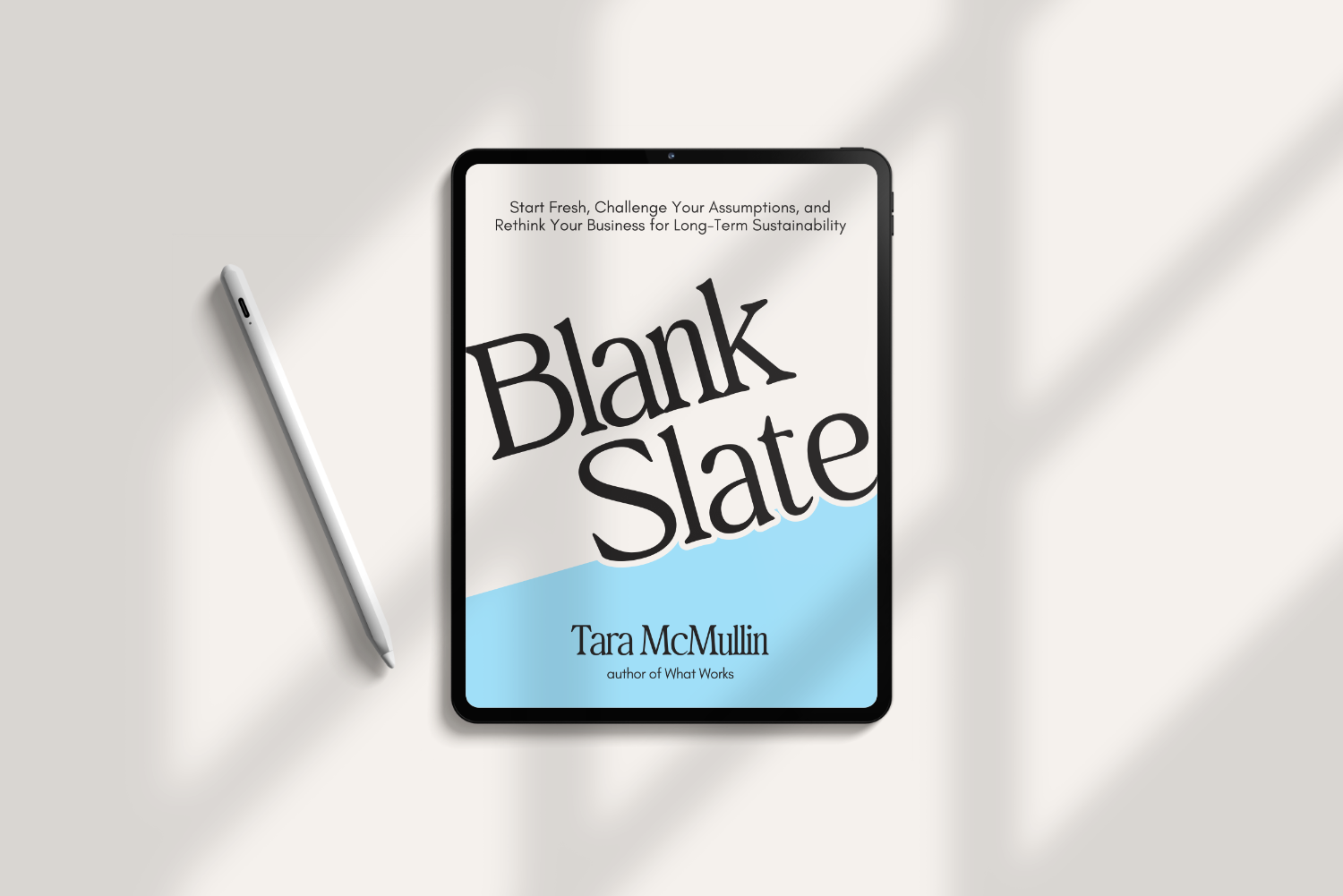
If you're ready to circle back on your business strategy and get clear on what your next phase of business could look like, check out Blank Slate. Blank Slate is your guide to rethinking how you've always done things by approaching business strategy—from goals to brand to business model to marketing—in a systematic way.
Blank Slate is a 140+ page guide and workbook (PDFs and audio version in one package) that helps you become your own best business strategist. I've distilled more than a decade and a half of working with and teaching small business owners how to think differently about their businesses and make smart and sustainable choices about meeting their own needs while delighting their customers or clients.