Grieving the Future Self

In the first season of The Pitt, Noah Wyle's character, Dr. Robby, guides two adult siblings through the death of their father. The brother is upset but accepting. The sister resists the facts of the situation and tries to hold on to her father for as long as possible, even against her father's wishes.
Dr. Robby tells the pair that his mentor introduced him to the Hawaiian tradition of Ho'oponopono as a ritual of saying goodbye to a loved one who is dying. "It's going to sound really simple," he tells them, "but I swear I've seen it work." Then, he shares the four phrases that make up the ritual: I love you, thank you, I forgive you, please forgive me.
The viewer watches as the siblings reminisce, air unsaid disappointments, and begin to grieve within the ritual's structure. The pair not only says goodbye to their father but also forges a deeper connection with each other. After all, these simple phrases are linguistic containers for the details of any close relationship—love and gratitude, yes, but also the acknowledgement of wrongs done by both parties.
I'm thinking about this scene today because I've been thinking about grief. But rather than grief at the loss of a family member or dear friend, I'm thinking about grief at the loss of oneself and how often we let that loss pass unacknowledged.
Growth Through Unlearning
In her book, Unlearning with Hannah Arendt (a title that sounds like a podcast I'd very much like to listen to), scholar Marie Luise Knott examines how Arendt unlearned traditional understandings of concepts such as laughter, translation, and forgiveness. In turn, these concepts can serve as guides or templates for unlearning other assumptions or beliefs we may hold. Just as in the ritual of Ho'oponopono, Arendt's social and political philosophy hinged, in part, on forgiveness.
However, it took her time to reach that understanding. Arendt had to unlearn a kind of pop-culture Christian definition of forgiveness to find a more impactful formulation—ironically, one she found in the Gospel of Luke. Reflecting on the original Greek, she came to see forgiveness not as a spiritual or transcendent practice but as an immanent and material one. In this way, forgiveness was not only extending grace in the aftermath of wrongdoing, but also "releasing" the other from the reasoning of their past. Forgiveness could be accepting that someone has changed their mind and releasing them from our association with their previous ways of thinking.
In The Human Condition, Arendt writes:
"Only through this constant mutual release from what they do can men remain free agents, only by constant willingness to change their minds and start again can they be trusted with so great a power as that to begin something new."
When I think about work, business, and leadership in the 21st-century economy, unlearning is always at the heart of my inquiry. What assumptions or beliefs am I holding on to? What assumptions or beliefs shape the prevailing narrative we're all bumping up against? What do we need to release to "begin something new?" These are philosophical questions, but they have material bearing on how we conduct ourselves in the world.
New understanding must always come at the expense of old beliefs or assumptions. That is, when we’re exposed to a new idea or perspective, we can’t do much with it until we dismantle the assumption or belief that it should replace. New ideas and perspectives can’t stick when layered on top of contradictory ones. You can learn them, but you can’t integrate them.
This is why it’s so easy to fall back into old patterns and so difficult to break unwanted habits. It’s not only the action that has gravity, but also (and to a much greater extent) the narrative within which those patterns or habits are situated. The narrative that stands between us and change or growth isn’t necessarily a bad one, though. Often, it’s a story we find solace or hope in: the can-do attitude, the promise of entrepreneurialism, the American dream, the arc of history, meritocracy, and so on.
Dismantling a narrative that brings us hope is psychically painful. We resist. We thrash. We fight.
Even when we successfully deconstruct the narrative preventing our growth, we’re not finished. Because that narrative doesn’t only exist in the past or present, it also exists in the future. It created a future that we’ve invested time and energy into bringing into being. And in the future, we also claimed an identity, a future self that we’ve grown rather attached to. When you deconstruct an aspect of your worldview—for example, that an unrelenting work ethic isn’t a sign of righteousness—you’re also tinkering with your identity and sense of self.
And the consequence of that kind of growth and change is very often grief. Grief at the loss of a loved one, but that loved one is a future self. Unfortunately, this is rarely a kind of grief we recognize, and almost never a kind of grief that leads to grieving.
Put a Different Way
Every time we ask a child (or ourselves) what they (we) want to be when they grow up, we conjure a possible future self. A speculative self. The child imagines themself as a rockstar, a paleontologist, or an artist.
Those early speculative selves flit in and out of existence without a second thought. A child might page through books about dinosaurs or spend rainy afternoons drawing scenes from their favorite stories, but their life proceeds in the same sort of general education path as their friends’ lives do. The dream of becoming a paleontologist effortlessly morphs into that of becoming a doctor or an influencer.
Over time and with greater agency, the speculative self takes on greater substance. The child becomes a teen who makes choices that propel them into the future they imagine for themselves. The teen becomes a college student who selects a major based on a speculative self. The more action they take to turn their speculative self into reality, the more that speculative self feels real.
And if they change their mind? If an insurmountable obstacle obstructs their path? If technology, or family, or the market pulls them in a different direction, and they let go of the speculative self that guided their action? Yes, there can be disappointment and frustration. There might even be excitement at the prospect of a new future self. But beneath the surface, I think, there’s grief.
And no one can release them from their previous thinking and action, save themselves.
This construction of future selves doesn't stop once we're grown-ups. Start a new job, meet a partner, move across the country, launch a business, have a child... each new major milestone—plus all the tiny ones in between—generates speculation about the future. And it creates a speculative self to inhabit it.
I’ve concocted many speculative selves over the years: the pastor, the professor, the bestselling author, the CEO, and so on. But it wasn't until a few years ago that I realized I hadn't allowed myself to grieve those selves, not least because I didn't realize that what I was experiencing was grief.
The way I approach my work is as a process of deconstruction and reconstruction. Said another way, unlearning and new learning. This process serves me well, but in recognizing the grief I experienced at the loss of my future selves, I discovered that grief also needed to be part of this process. Intellectually, I can deconstruct and unlearn false assumptions. But if I don't also process the deeper, more emotional core of those assumptions, I can't fully begin something new.
The future selves and situations I'd constructed on the foundation I'd just dismantled needed to be acknowledged. I needed to grieve—to express gratitude, to forgive, to be released. To move forward without being weighed down by unacknowledged grief, I needed to look those selves in the eyes and say, "I love you. Thank you. I forgive you. Please forgive me."
I needed to say a proper goodbye, recognizing that the grief wouldn't go away but that it was bearable if I knew better what I was dealing with.
One More Thing
I suspect that grief will be a defining experience of the millennial generation. Not because we experience loss more than other generations, but because many of us live with a nearly incalculable loss of imagined futures. We grew up being told we could do anything, be anything we wanted. And, faced with the realities wrought by economic, technological, and political systems, we are realizing that the society that told us those things has changed its mind.
And not only do we feel this experience of grief over lost futures on a personal level, but we are also collectively feeling it on a political level. "Who we are" as a polity is revealing itself to be less invested in liberty, justice, and the pursuit of happiness than we (at least middle-class white children) were led to believe it was. And even if we unlearned that elementary school notion long ago, many are just now starting to grieve.
While this might all sound bleak, I actually see the opportunity to grieve as an opportunity to begin a new phase—of life, of work, of politics. It's a chance to tell a different story and imagine a new future based on everything we've learned after a hearty encounter with unlearning. And it's this new story that can inspire a whole new approach to our day-to-day life and work such that a better future is indeed possible, even probable.
To my old selves—past and future—and to my old understandings of the systems at work in the world: I love you. Thank you. I forgive you. Please forgive me.
Rethink Your Business
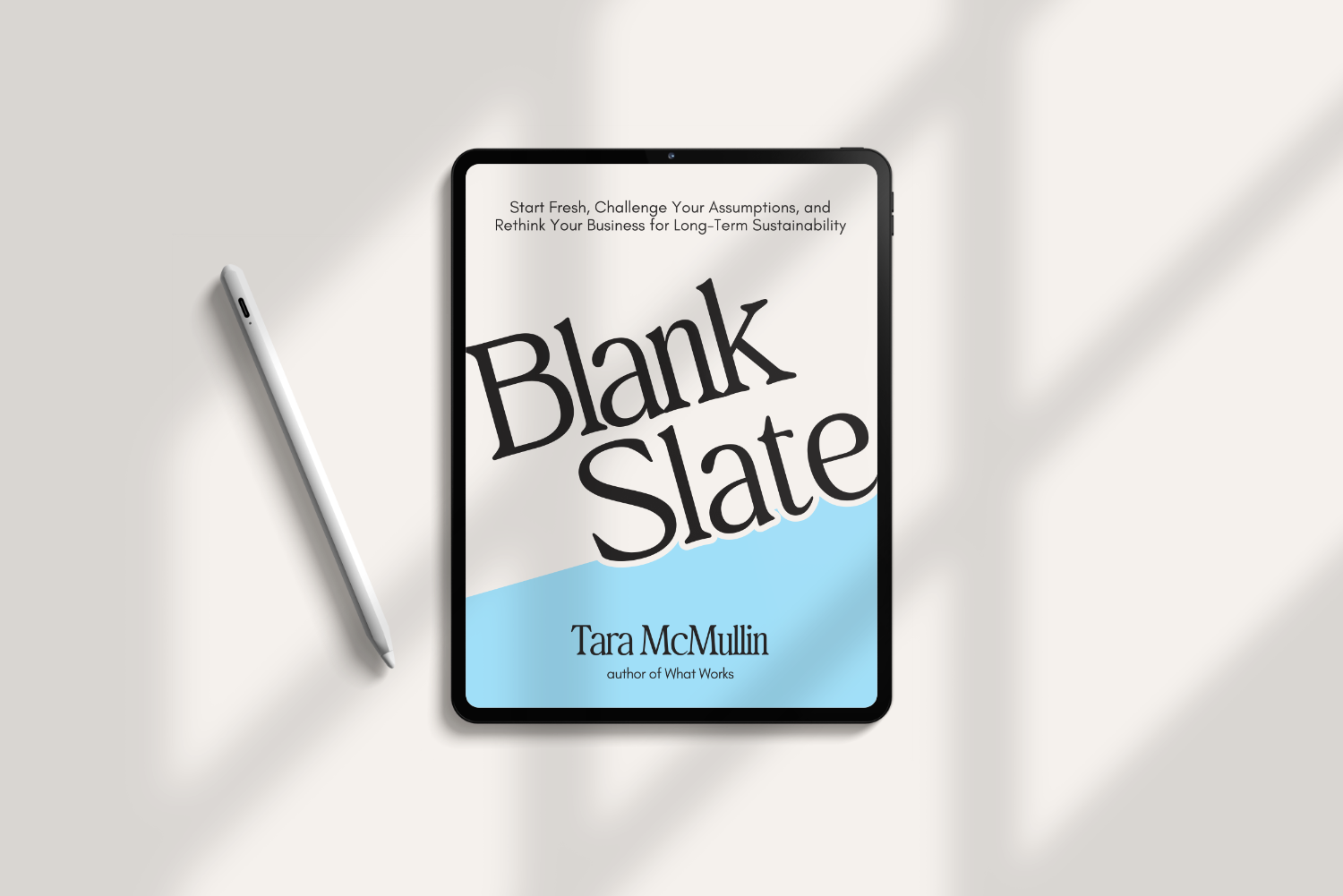
If you're ready to circle back on your business strategy and get clear on what your next phase of business could look like, check out Blank Slate. Blank Slate is your guide to rethinking how you've always done things by approaching business strategy—from goals to brand to business model to marketing—in a systematic way.
Blank Slate is a 140+ page guide and workbook (PDFs and audio version in one package) that helps you become your own best business strategist. I've distilled more than a decade and a half of working with and teaching small business owners how to think differently about their businesses and make smart and sustainable choices about meeting their own needs while delighting their customers or clients.