Circling Back
Last year, around this time, I wrote about the difficult task of consolidating more than a decade and a half of personal and professional evolution into a single website. It was (and is) a process of self-reflection and self-curation—all wrapped up in a feeble attempt at information architecture. I considered the implications of all the broken links, literal and metaphorical, strewn around my online life.
Literal broken links, while frustrating, had technical explanations. When I found one, I knew why it happened and how to fix it.
However, another part of the consolidation process was frustrating in a more existential sense. As I went back through my archives to visually tidy up articles from the recent past, I was regularly confronted by the fact that I didn’t remember the essay in front of me. This was especially jarring when the argument or prose was, to my mind, good.
It’s one thing to forget about something unpolished or less-than-compelling. It’s another thing to lose track of an idea that really landed.
But such is the life and work of a hacker.
Today, I want to talk about hacking—and specifically, how intentional hacking reminds me to circle back, to evolve and progress my thinking rather than regurgitate or repurpose it.
Hack This
I’ve discussed McKenzie Wark’s concept of the “hacker” before.
"Hacking" has been at the back of my mind for the last few weeks as I worked to finalize Blank Slate, my “new” workbook on reimagining your small business for greater sustainability and ease. In a way (and I don’t mean this pejoratively), Blank Slate is a hack. I took work that I’ve created, improved, and field-tested over the last 15 years and produced something new from it.
I don’t want to defend the political economy that profits from hacking—that is, the set of incentives and constraints that leave so many of us consistently looking for new shapes for old ideas, not to mention losing track of what we've already created. But I think that hacking has been a process that’s allowed me to grow as a thinker and has helped me develop an appreciation for maintenance systems and incremental progress.
To be clear, when Wark talks about hacking, she's referring to the many ways we all create information today. Every website you visit, every location ping your phone receives, every time one of your devices gets close to someone else's device—these are all events that create information that flows through companies that have made it their business to turn that data into a flow of dollars and cents. Today, though, I want to zoom in on the information work (i.e., the hacking) that's legible as such: producing knowledge, communicating ideas, sharing stories, gathering research, and other more overt forms of creative production.
So I’m playing a little fast and loose with her idea, but I think it’s a good framework for examining this process. Before I tell you more about how Blank Slate is a hack, let me tell you about the first ebook I ever “wrote.”
Then and Now
The first ebook I ever wrote (published at the tail end of 2009) was called 52 Weeks of Blogging Your Passion. It opened with some general advice on how blogging could support a creative business as a form of marketing. The main part of the ebook was a set of 52 prompts for writing blog posts. For example, "Share an important step of your process and how you came to do it the way you do."
I have no memory of how many I sold or what kind of revenue it generated. At the time, my primary business was still direct sales of display ads. But I know I was pleased with sales and continued creating digital products, including a second book of prompts called (you guessed it) 52 More Weeks of Blogging Your Passion.
52 Weeks was a guide to hacking. How do you take this thing that you do (e.g., drawing, designing, knitting, etc.) and produce content from it week after week after week? How do you produce something different every week from the same process?
The ebook itself was a hack, too. I took the kinds of questions I asked in written interviews with makers and reworked them into a content strategy business owners could apply to themselves. To call it a hack isn't meant to downplay its value, but to acknowledge that 52 Weeks wasn't a knowledge product that went from nonexistent to existing in a self-contained way.
My latest project followed a similar process.
On January 2, 2025, I went into my Canva archive and found three resources I’d created previously: a participant guide for a virtual retreat I hosted in 2021, a slide deck for a workshop I taught in 2024, and a workbook for a program I taught through another company also in 2024. I copied each of those resources into a new project and started to sort through the various pages. I combined what was redundant, reordered what was left, and started to note what was missing.
I worked on it in fits and starts. I revised and updated. I wrote and diagrammed. I borrowed and reworked. By May, I’d gotten through about a third of what I thought the guide required. But then Summer Seminar started, and then Making Sense, and all throughout the year, my kid was making final decisions about college (which took up an unexpected amount of my mental bandwidth in addition to considerable time).
I picked it back up in November and committed to finishing it. And now, it’s done. At least the first edition. I’m sure I’ll update it plenty more.
Not only is Blank Slate the product of three previous iterations of teaching on business development and strategy, but it’s also the product of countless conversations with clients and students over more than 15 years. Some of the exercises—like the Perspective Map—are ones I’ve used over and over again. Others are the great-great-grandchildren of long-defunct exercises.
I could have created this guide years ago, but I think the reason it started to come into focus a year ago was because I was in the process of consolidating my various old websites, a process that required me to revisit everything I’d written in the previous three years, plus all of my “greatest hits” from the five to eight years before that.
Going back through old work can be a bit, as the kids say, triggering. As in, it’s embarrassing. However, there were also moments when I thought, Wow, I wrote that?!
Old work doesn’t resurface the way a memory does. Reading, watching, or listening to forgotten work isn’t transportive; it doesn’t take me back to a forgotten experience. It doesn’t remind me that life and its experiences are fleeting. It reminds me that my day-to-day work is largely ephemeral—weightless. Even when, as has become increasingly frequent, rediscovering old work is a pleasant surprise, the feeling is bittersweet. I feel good about what I once made, but disappointed that I forgot something I worked so hard on.
The political economy that produces hacking as a labor process also renders the products of that labor process disposable.
There's no incentive to go back to my old Instagram posts, just as there's no reason to reuse a Kleenex. In fact, more often than not, doing so has negative consequences.
What I’ve learned in the process of reshaping my work, the process of hacking, is that just because real pressure exists to make something and immediately forget about it, I don’t have to bend to that pressure.
There were times when I was working on Blank Slate when I did, in fact, go back into my old Instagram posts to see how I’d diagrammed something in the past or what metaphor I used to communicate an idea. I went back into resources I’d created in 2019 and courses I taught in 2016. This work isn't actually disposable. I've just treated it that way because that's how the incentives line up.
Unlike a Kleenex, the only thing that can make my older work disposable is… me. It’s up to me to resurface it, to improve it, to re-engage with it.
Writer Anu Atluru offers a similar metaphor for thinking about the incentives that shape how we create today. She distinguishes between “heavy things” and “light things.” Heavy things require time, thoughtfulness, and care to create. Light things are fast, superficial, and frictionless. The “modern makers’ machine,” she writes, “resists weight and avoids friction. It does not care for patience, deliberation, or anything but production.”
I like this metaphor very much—although I’ll admit that I prefer to draw less stark lines between categories.
I believe that an Instagram post can, to mix metaphors a bit, punch above its weight. I made it my goal to create heavy Instagram posts for a while, and those were exactly the posts I went back to while creating Blank Slate. An Instagram post that stands the test of time, that’s worth coming back to, that begs to be reworked and improved upon, resists the conveyor-belt logic of the corporatized internet.
Resisting ephemerality and returning to old work in a system that prioritizes the new can be a source of power. It’s not the kind of power that will topple the system—we need solidarity and collective action for that. But it is the kind of power that can help us gather resources for more consequential resistance in the future.
Hacking the World
Jenny Odell links the information environment to the physical environment throughout her book, How to Do Nothing. She writes:
Just as practices like logging and large-scale farming decimate the land, an overemphasis on performance turns what was once a dense and thriving landscape of individual and communal thought into a Monsanto farm whose “production” slowly destroys the soil until nothing more can grow.
I can't think of a better metaphor for the kind of creative burnout that easily results from hacking. The short-term incentives that shape hacker labor reward a kind of monocultural approach to knowledge production and creative expression. There are only so many times you can sow and reap the same creative crop before the soil is utterly depleted.
Note that it's the goal that creates the problem: an "overemphasis on performance." Just as it's not farming that's the problem with hyper-optimized, production-oriented agriculture, hacking isn't the problem with a hyper-optimized, production-oriented information economy. The system relies on overemphasizing performance to eke out greater and greater profits. All the visible incentives point us toward bigger crop yields without regard for meaning, quality, or value.
For years, I dutifully created content for Twitter, then Facebook, and then Instagram, finding new ways to talk about the same old things. And when the goal is simply figuring out what to deliver to the algorithm god five days a week, it’s not fun or fulfilling. We didn’t need AI to create slop; we were perfectly capable of it ourselves. Without care and intention, hacking inevitably creates slop, but with care and intention, the result can be quite different.
Wark's definition of hacking evokes a sense of cyclicality. When done for the wrong goal (i.e., the overemphasis on performance), hacking is a reinforcing feedback loop that spirals out of control. With different aims, however, there is balance. Odell writes:
This is something like a goal without telos, a view toward the future that doesn’t resolve in a point but rather circles back toward itself in a constant renegotiation.
This is the kind of hacking that I've been trying to practice for the last few years. Circling back and renegotiating my ideas (or knee-jerk responses masquerading as ideas). Revising and improving and asking new questions. Complicating and simplifying. Rethinking.
I realize that what I’m describing as hacking is really the age-old process of iteration. We take our ideas and improve on them. We return to them, reshape them, experiment with them, expand on them, and produce the next iteration. The political economy of hacking would have us forget to return, to iterate. Its performance depends on our forgetting. But the actual work process of hacking is an iterative process that continually improves upon its product.
Hacking isn't new, but hacking as a production process is.
The key to reclaiming hacking is to create processes or tools for circling back. On a recent episode of The Vergecast, Platformer founder Casey Newton described how he used an app to capture ideas and randomly resurface them in a daily note. Yes, I downloaded that app the next day, and I’m digging it. He also used Claude Code to create an interactive database of more than 800 past editions of Platformer. I haven't done this yet, but I plan to—like Newton, I've wanted something like that for years.
With the rise of personal knowledge management apps, there are more tools for circling back today. But we do have to seek them out. Instagram isn't designed to remind you of that heavy post you made three years ago. WordPress or Substack or Squarespace isn't going to proactively point you back to that quick post you made last year that could be expanded into a more substantial essay. There's just no upside for them to do that, so it's up to us.
Before the so-called creator economy coalesced in its current form, there was a lot of talk in small business marketing circles about getting off the “hamster wheel” of content creation. This metaphor belies the creative emptiness of hacking in the current political economy. Whether or not you're a "content creator," there's probably some aspect of what you do that has that "hamster wheel" quality. It might seem like least valuable, least creative part of your work. Yet, I have a strong suspicion that this is an aspect of your work that has the potential to be reworked and approached anew.
Running as fast as you can and getting nowhere sucks. But put that same effort into getting somewhere you want to go, and the experience changes completely.
You don’t even need a destination in mind to transform the experience of hacking. You don’t need to have set your sights on writing a book, creating a course, or developing a method. Putting your effort towards finesse or clarity can be enough to turn your experience into something meaningful. I'm talking about making media because media-making is my context, but this idea of re-engaging with the work on our own terms applies to all sorts of hacking.
Circling back isn't the same as going nowhere fast. Circling back is how we get anywhere worth going. Circling back is a practice of presence with our own work. Rather than dwelling in the past, circling back invites us into a more substantial future.
What could you circle back on today?
Rethink Your Business
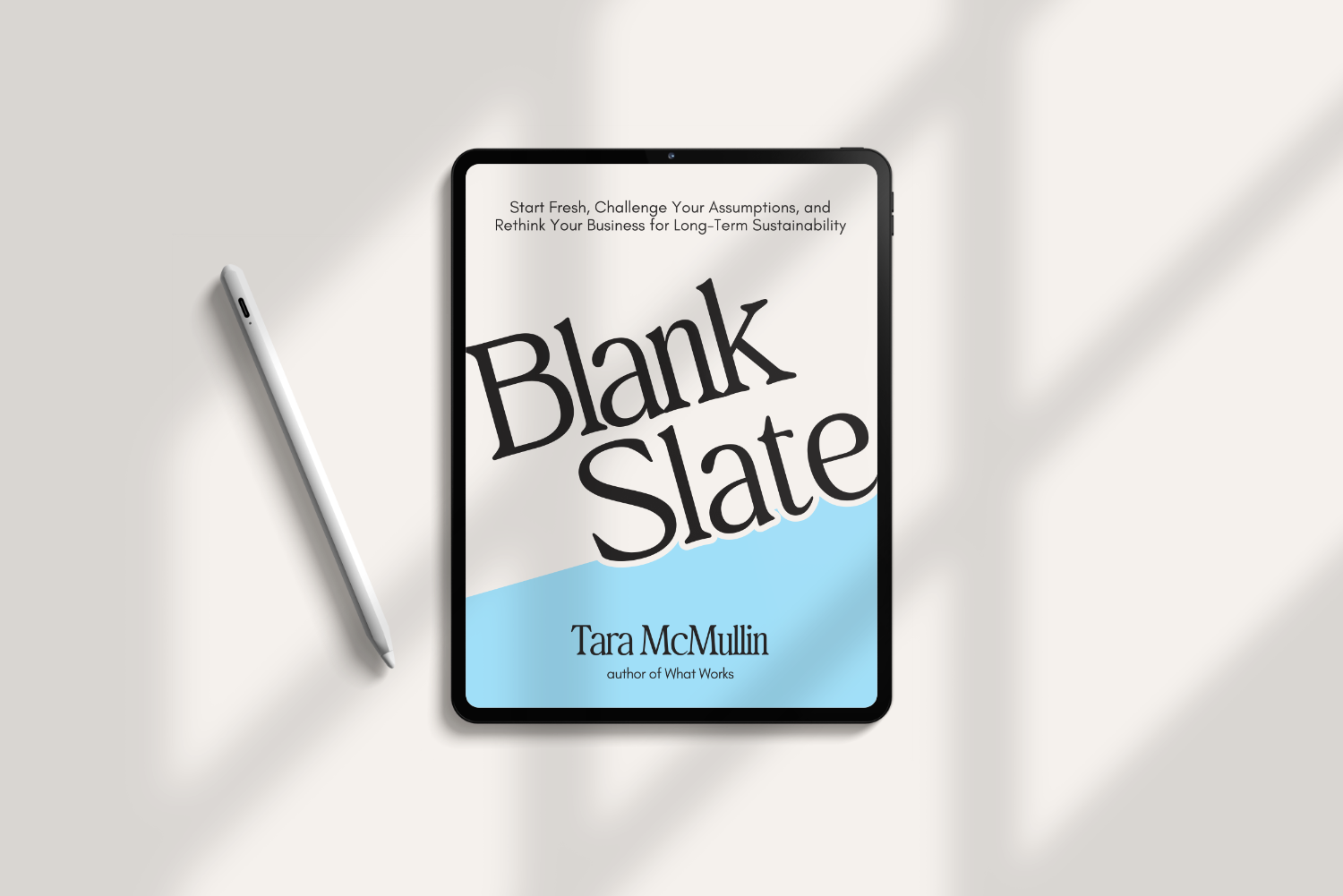
If you're ready to circle back on your business strategy and get clear on what your next phase of business could look like, check out Blank Slate. Blank Slate is your guide to rethinking how you've always done things by approaching business strategy—from goals to brand to business model to marketing—in a systematic way.
Blank Slate is a 140+ page guide and workbook (PDFs and audio version in one package) that helps you become your own best business strategist. I've distilled more than a decade and a half of working with and teaching small business owners how to think differently about their businesses and make smart and sustainable choices about meeting their own needs while delighting their customers or clients.